Student Monograph ~
Comfrey
(Symphytum officinale (3), S. x uplandicum (MNG))
This Materia Medica assignment (new, more in-depth style) was written by Kate Duinkerken
with additional input from Maria Noel Groves (MNG) and Liane Moccia (LM).
Common Names: Comfrey, Knitbone (3) Boneset, Boneknit, Bruisewort (4)
Family: Boraginaceae (3)
Part(s) Used: Aerial Parts, Root (3). Internal use of the leaf is generally deemed not safe, and the root is for external use only, see cautions and nuance below.
Key Actions: Demulcent, Astringent, Anti-inflammatory, Wound and Bone Healing (3), Analgesic (pain relieving), Antioxidant, Antirheumatic, Expectorant, Vulnerary (5), Emollient, and Hemostatic (4)
MNG: I don’t generally consider comfrey astringent nor drying, but herbalists never agree 100%, especially not for a plant like comfrey.
Flavor: Salty, Sweet (5), Mucilaginous Texture and Cucumber-y Aroma (MNG)
Energetics: Moist, Cooling (5) (MNG: most sources),
though some sources indicate Drying (2)
Identification/Growth:
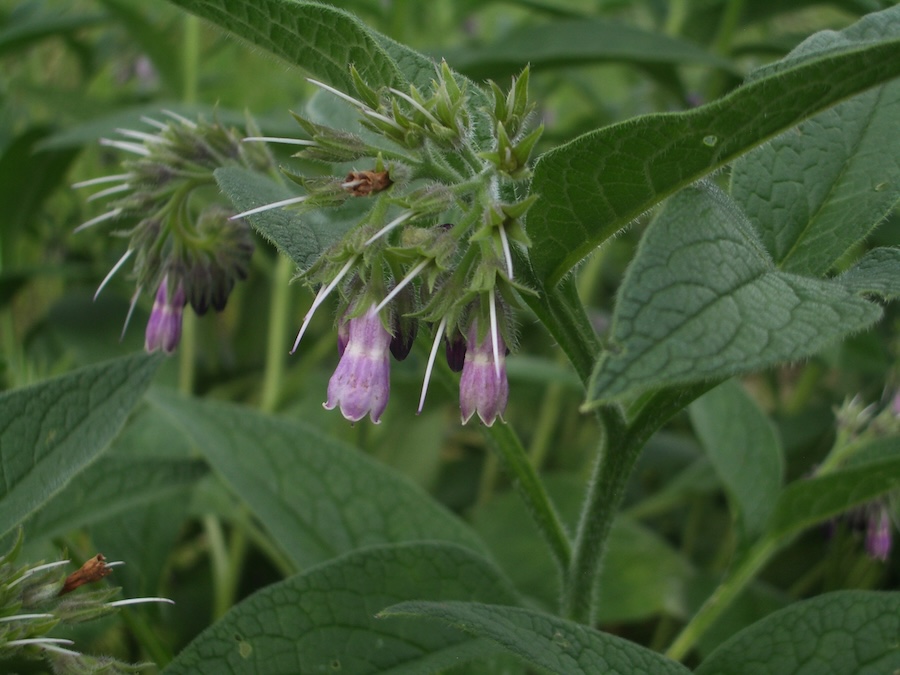
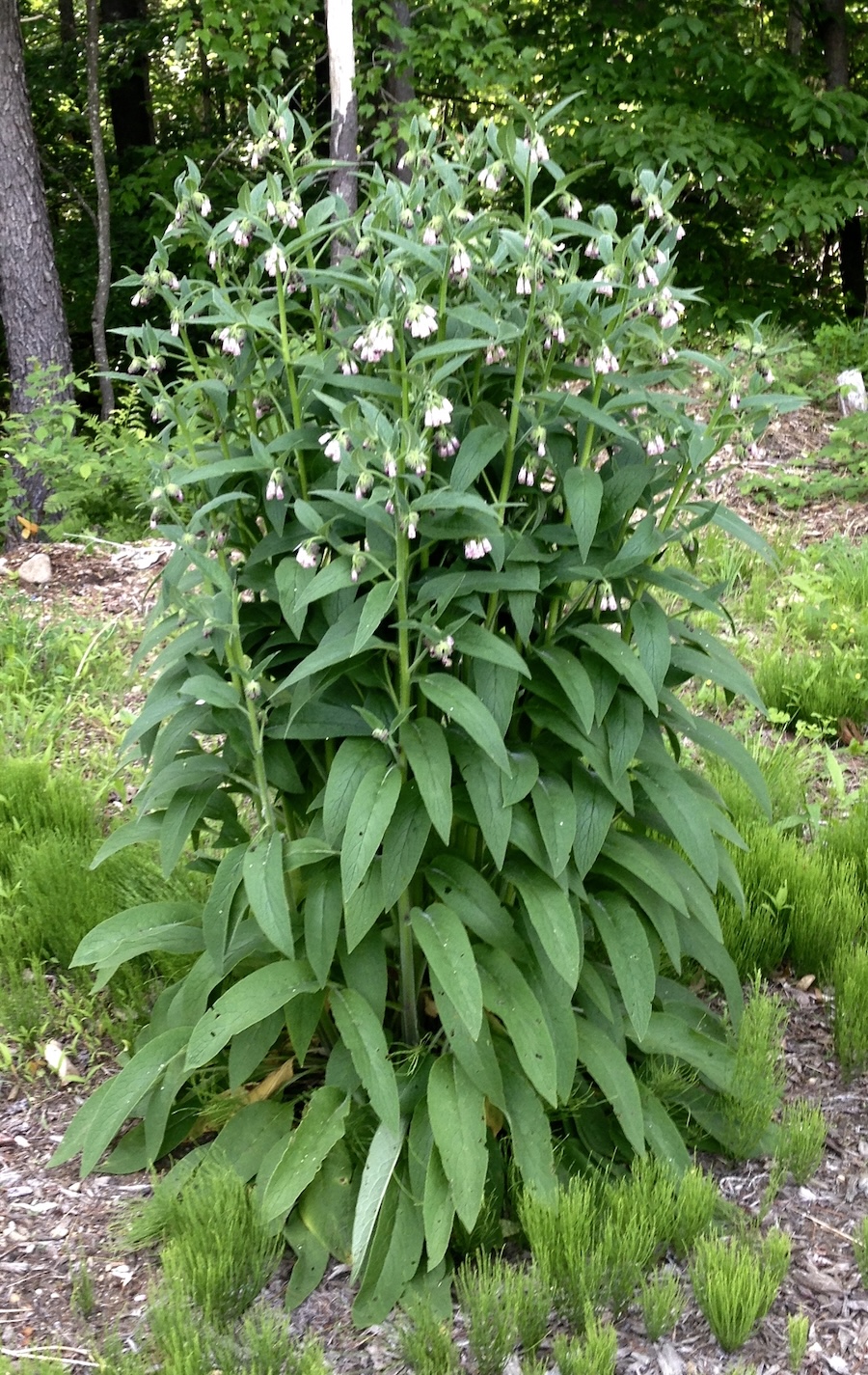
Comfrey is a perennial, native to Europe, that grows to three feet, with thick leaves and bell-like white to pink or mauve flowers (3). It grows in all temperate regions of the world, including Western Asia, North America and Australia, thriving in moist, marshy places (3). It can be grown from seed in spring or root division in the fall (3). The smell of the leaf is fresh, slightly salty, cucumber-like and mildly sweet, indicating the mineral and polysaccharide content (5). Breaking open a leaf (MNG: or root) will reveal a slimy mucilage (5).
MNG: Russian comfrey is often grown in gardens as “comfrey” and used somewhat interchangeably. It’s reported to be a hybrid of S. officinale and S. asperum originating in Russia, eventually sent to London and then the United States a a popular forage and garden crop (note cautions).
Harvesting/Preparation/Dose:
The root is harvested in the fall when the allantoin levels are highest (3). Leaves and flowering tops are harvest in the summer (3). MNG: Note leaves have fewer of the potentially problematic PAs – discussed in cautions – and older leaves generally have fewer PAs than younger leaves… though may still be problematic as PA counts vary widely batch to batch.
TOPICAL PREPARATIONS
- Topical preparation – prepare leaf oil using the alcohol intermediary oil method, or infuse the leaves or root using the double boiler method. Apply comfrey topically as a apoutice, fomentations, cream, salve, ointment, balm, paste, wash, bath, sitz bath, mouthwash, vaginal irrigation, or enema (4).
- Infused oil of leaves – apply to sprains (3).
- Chopped leaves – apply as a poultice to boils (3).
- Ointment of leaves – apply to bruises (3). 5-30% root extract, applied 3 times a day (5).
- Topical Tincture – fresh roots 1:2 @70-95%alcohol; second cutting of fresh leaves 1:2 @70-95% alcohol, dry leaves 1:5 @60% alcohol, consume 5-60 drops, up to three times daily (4). Apply root tincture undiluted to acne (3).
Maria’s Perspecive and Additions on Comfrey and PA Safety:
- I love comfrey, but there are real safety concerns: Let me preface this by saying I love comfrey as a plant and medicine and feel deeply connected to it, but I am also moderately cautious in how I work with it. While many herbalists including some I deeply respect consider comfrey much maligned and generally safe, my own exploration into the literature and care reports gives me pause. I believe much of the herbal community is repeating outdated, inaccurate, and unsafe rhetoric. Comfrey concerns are real and relevant, not just from lab studies of isolated constituents force-fed to rodents in high doses.
- There is a rare but very real and potentially dire risk of liver damage from comfrey.
- Human Cases Exist: There are human case reports from both large and more typical doses of regular comfrey (including leaf-only and water-extract only) and other PA-containing plants causing liver failure and, in many cases, death. One case was shared on an herbal forum by an herbalist I know whose mother consumed the typical “super infusion” style comfrey leaf tea regularly and died of PA-induced liver failure. Other cases in the literature include a man with cancer eating copious amounts of comfrey doing a “cleanse.” Another is a woman consuming a mixed herbal formula for respiratory health that contained the PA-plant coltsfoot; she was fine, but she was pregnant and her baby was born with veno-occlusive disease and died. (Some of these and additional cases are outlined via the Comfrey Central and Paul Bergner resources below.)
- PA Content and Impacts Vary Widely and Somewhat Unpredictably: Studies and cases also clearly show that PA content varies widely batch to batch and that people also have individual and sometimes unpredictable responses to PAs. It’s true that generally the roots have far higher PAs than the leaves, and that older leaves (our “safest” option) have fewer PAs than younger leaves. Some herbalists report that one species is safe while another is not. This isn’t really true (see the Comfrey Central charts). What is true is that PA content varies widely batch to batch. So, one herbalist’s patch of one species may be low while another species in their garden, but when you look at multiple batch tests, you’ll see that both species can be very low or extremely high. Additional nuance: Repeated/later harvests may have fewer PAs vs earlier harvests. Richer soil, sunnier spots, and drier soil tend to produce higher PA plants vs poorer soil, shady, and more moist spots.
- Solvency? I haven’t seen much supportive data, but the belief is that alcohol extracts PAs more readily while water and especially oil, less. That said, case reports of liver toxcity in humans have occurred from eating comfrey as food, drinking comfrey as tea, and low doses of coltsfoot in an encapsulated formula.
- It’s all a game of chance. How willing are you to risk your liver (or your clients’, family’s, livestocks’) for healing properties you can probably get from other plants much more safely??
- How Comfrey/PA Liver Damage Presents: The type of damage comfrey and other pyrolizadine alkaloid(PA)-rich plants cause is unique, slow, cumulative and doesn’t show symptoms nor lab abnormalities until it reaches an advanced, life-threatening state. PA-induced liver damage specifically causes veno-occlusive disease, which has a different presentation than other causes of liver damage (Tylenol/acetametophin, alcohol, medications, diabetes-induced fatty liver disease, etc).
- Topical Safety and Considerations:
- While studies suggest that PAs can be absorbed via the skin, this seems to be minimal, and I am of the mindset that topical use is likely safe. Many studies show benefits for a wide range of ahces/pains, repair (as Kate notes), and I love working with comfrey leaf oil clinically in my practice for this. I probably wouldn’t, say, bathe a baby in comfrey tea regularly, though.
- However, because comfrey heals tissue so rapidly, it can seal in infection, and I have also seen it cause fast but low quality wound remodeling – thick keloid ropy scars, etc. I generally prefer slightly slower but more sophisticated woung healing herbs like comfrey, gotu kola, plantain, and St. John’s wort (among many others). Though I would consider comfrey topically in a lower percent in formula, topically on properly set bones, and for general resolution repair/integrity of old wounds.
- Other Popular Comfrey Uses
- Animal Fodder? Even though many people use comfrey as fodder for livestock – it is indeed nutritious (rich in minerals and protein) – it still has the potential to cause liver failure in animals, just like it does in humans.
- Garden Ammendment? Unfortunately, new studies on PA-rich plants like senecio show that nearby plants like lemon balm, parsley, and chamomile can update PAs in somewhat similar levels as the PA-containing plant, which is very concerning. This calls into question the practice of using comfrey as a fertilizer crop or fermented tea. (Which I myself reocmmended in my early books before this research emerged. I looked over the full text studies hoping to find a loophole, but the results while preliminary were very concerning. I now keep my comfrey separate from crops I ingest.)
- Homeopathic? Flower Essences? In addition to most topical situations. I am also comfortable with comfrey internally via highly dilute remedy formats: flower essence and 30C/10X or higher dilution homeoapathics (NOT 1X, which is still 10% comfrey). In these high dilutions, there is basically no chemical representation of PAs nor the plant itself.
- Note that other PA containing plants include senecio (very toxic and not as popular in herbal medicine), borage (lower amounts of PAs), coltsfoot, and boneset/Eupatorium.
- Side Note On Poisonous Look-Similar Leaves: Before it blooms, comfrey leaves are not particularly distinctive and sometimes mistaken for other plants, such as the incredibly toxic plant foxglove. Just one cup of tea or leaf in your smoothie of foxglove is rapidly deadly (where as the risk of a single dose of comfrey is quite low). This is totally separate from the PA-liver toxicity discussion (totally different speed, mechanism of death, etc) but important to note to proper ID is important. A few case reports of death from foxglove (when people thought they were harvesting comfrey) exist.
Sources & Resources
Additional resources from Maria
This goes beyond what I would expect from a beginner/intermediate student in their homework, but I feel like many would find these more advanced sources insightful:
On Comfrey & PA Safety
- Comfrey Central, by Dorena Rode, last updated 2004, is loaded with helpful, evidence-based, and minimally biased information on comfrey and PAs, supported in part by the National Institutes of Health (NIH) National Center for Complementary and Alternative Medicine (NCCAM) fellowship (#F31 AT00656-01). For more information about funding for complementary and alternative medicine research visit the NIH NCCAM web site. (This statement doesn’t imply that the material in this site was reviewed, approved or authorized by NCCAM.) https://www.comfreycentral.com/ including…
- Case reports through 1992 (and other study data)
- Note that Maria Noel Groves is aware of at least one other human case – an herbalist in the USA community on a forum reported that her mother followed the popular super-infusion style leaf tea, drinking regularly, and died of veno-occlusive disease-associated liver failure; however, this case anecdote may not be available in the scientific journeys.
- PAs in comfrey including charts of data on different parts and species – you will see that the quanties vary WIDELY plant to plant and that none of the common species can be assumed to be low/free of PAs, though leaves generally do have far fewer PAs than roots (they can still provid potentially toxic levels) https://www.comfreycentral.com/research/comfrey_pa.htm
- Case reports through 1992 (and other study data)
- Additional articles and studies: de la Foret, Easley, Dharmananda, Comfrey studies on PubMed, PAs on PubMed. Herbalist Paul Bergner also speaks widely on this, such as in this MedHerb article.
- Studies on PA-containing plant transfer via soil to other plants (note that the full text for these is harder to get, sometimes you can find them via Sci-Hub, but the links change often) Nowak and Selmar , these studies were more specifically on Senecio (a more toxic plant) but likely also occur with comfrey. While one study by Chmit (full text here) determined a lesser risk, the evidence they provided is less convincing – and odd that they list “comfrey” on the study title yet use a completely different and obscure plant (Lappula squarrosa) in the resarch trials. More nuanced research would be great to help clarify all of this further, ideally on the comfrey species we love and grow.
Russian Comfrey
- Botanical Society of Scotland, Russian Comfrey May 26, 2025 https://botsoc.scot/2025/05/25/plant-of-the-week-may-26th-2025-russian-comfrey-symphytum-x-uplandicum/
- Strictly Medicinal Seeds, Richo Cech, profiles on Russian Comfrey and True Comfrey
Sample Monograph by student Kate Duinkerken with additions from Maria Noel Groves, RH(AHG) and education advisor Liane Moccia, RH(AHG). Featuring the newer, more detailed monograph homework style.

About Kate Duinkerken
Passionate about learning, Kate has spent many years becoming knowledgeable in the healing arts, with certifications as a Transformational Healing Practitioner, Child Meditation Facilitator, Usui Reiki Master, and completing a Shaman Apprenticeship with Bloom Post. Kate has also completed many other courses in religious studies and practices, hand and foot reflexology, and mindfulness practices, learning comprehensive and empowering ways of helping others release stagnant energies from their bodies. Working as an intuitive energy healer for the past eighteen years, Kate started learning herbalism under the guidance of Maria Noel Groves with Wintergreen Botanicals. Ultimately, Kate desires to learn how to integrate herbs to help facilitate the healing of the physical body, while complementing the release of stagnant energy from the body and surrounding systems. It is with great honor that Kate serves those in her community, and herbalism is a perfect tool to offer to those on their healing journey. Kate’s favorite herbal therapies include making broths, formulating teas, providing oil formulations, and making salves for her family, friends, and others who have been called to receive these remedies. When Kate is not spending time with her family or working in the community, she enjoys spending time with the animals on her hobby farm, hiking, or working in the garden.
Kate has completed Wintergreen Botanicals’ Home Herbalist and Beyond the Home Herbalist series and joined the team as an education advisor in 2025-2026.
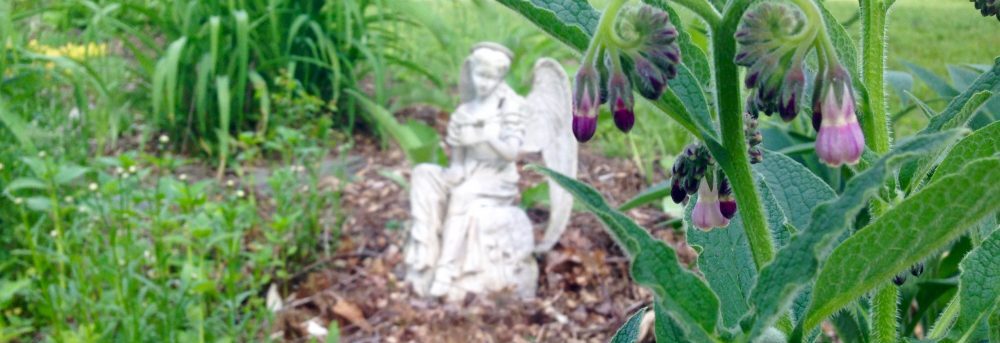
Comfrey Photographs by Maria Noel Groves (the species pictured is likely S. x uplandicum)
The statements made on this blog have not been evaluated by the FDA and are not intended to diagnose, prescribe, recommend, treat, cure, or offer medical advice. Please see your health care practitioner for help regarding choices and to avoid herb-drug interactions.
Follow Maria and Learn More About Herbs: Monthly Newsletter, YouTube Channel, Facebook, Instagram